
Quick Facts
- Level
- Essential
- Category
- Waqf and Ibtida
- When it occurs
- It occurs when the reciter pauses at a suitable place in a word sequence, commonly at the end of a meaningful phrase or verse.
- Letters involved
- Context-dependent
What is Waqf?
Think of waqf as a planned pause, not simply taking a breath anywhere. Before stopping, ask whether the meaning is complete or whether the next words are needed to understand it. When you stop, the final letter is usually read with sukoon, so the ending can sound different from continuous recitation. In Hafs, practise waqf together with the printed signs in your mushaf and with teacher correction; the signs guide the reader but do not replace understanding the meaning.
When does it occur?
It occurs when the reciter pauses at a suitable place in a word sequence, commonly at the end of a meaningful phrase or verse.
Which letters are involved?
This topic is determined by context rather than a fixed letter set.
How is it pronounced?
At a stop, give the final letter its stopping form—usually sukoon. Tanween is removed, and ta marbuta is generally read as هْ when stopping; practise these endings with a qualified teacher.
Examples
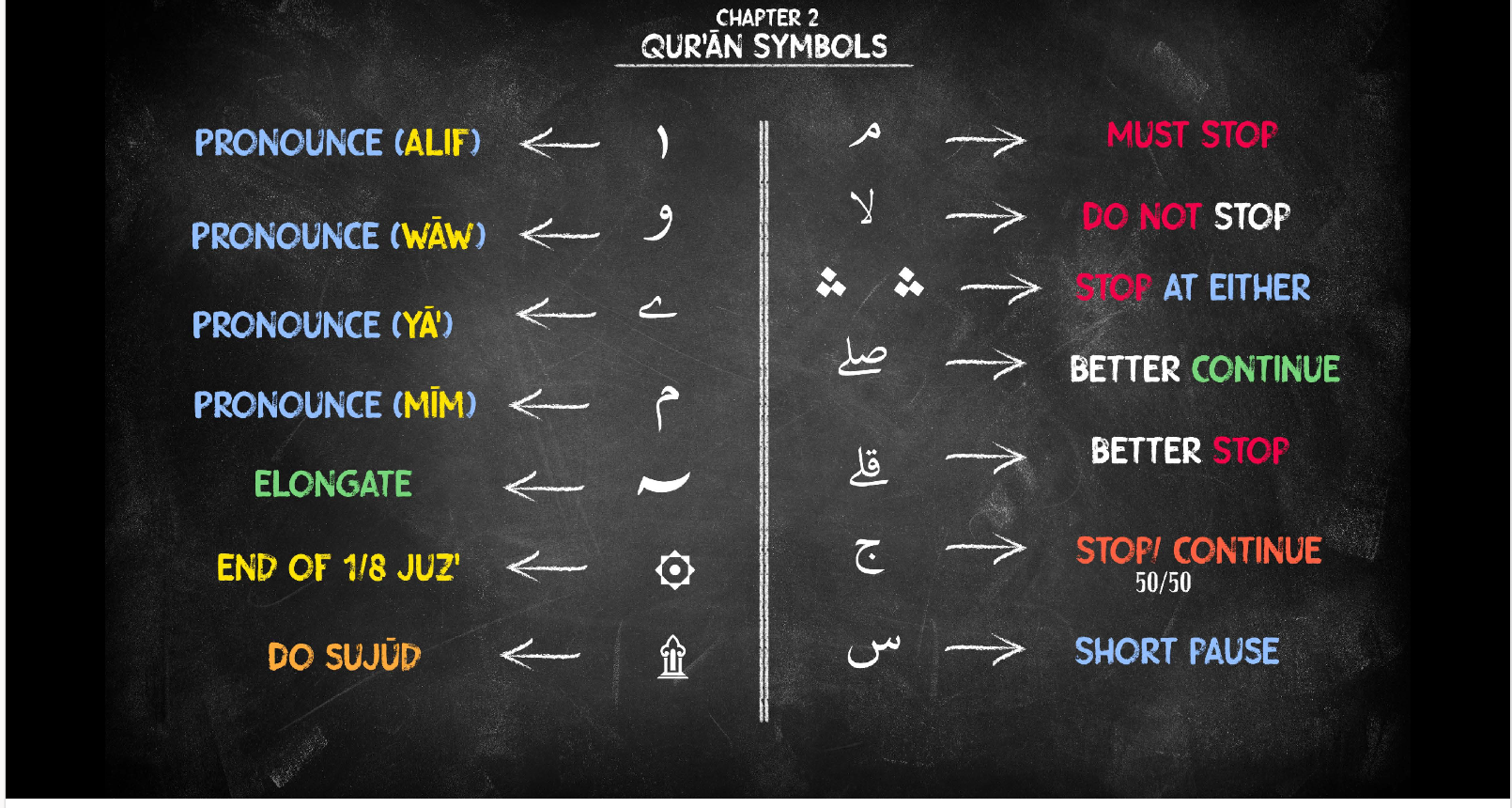
- Find the mark in your mushaf.
- Read the instruction beside the matching symbol.
- Protect the meaning before you stop or continue.
- Remember that editions can differ; your teacher and your own mushaf take priority.
The examples below are clearly labelled teaching examples and are not from the Quran. Use them to notice the rule, then confirm your recitation with a qualified teacher.
قُلْ — qul (say) — Not from the Quran
قُلْ — qul (say) — Not from the Quran
Common Mistakes
- Stopping in the middle of a phrase when the meaning is not complete.
- Keeping the final short vowel when stopping instead of applying the stopping form.
- Treating every mushaf symbol as an absolute command without checking the meaning.
Important Differences
Waqf and Ibtida
Study the condition, letters, and sound of Waqf alongside Ibtida so the two patterns are not treated as interchangeable.
Compare IbtidaWaqf and Madd Tabii
Study the condition, letters, and sound of Waqf alongside Madd Tabii so the two patterns are not treated as interchangeable.
Compare Madd TabiiWaqf and Hamzat al-Qat'
Study the condition, letters, and sound of Waqf alongside Hamzat al-Qat' so the two patterns are not treated as interchangeable.
Compare Hamzat al-Qat'Remember
First protect the meaning, then apply the correct stopping form to the final letter.
Practice
Try to identify the trigger first, say the sound slowly, then listen and repeat. Short, accurate practice is more useful than rushing through many examples.
- Why is Waqf distinct from a letter rule?
- How can stopping affect pronunciation in a recited passage?
Question 1 of 2
What is Waqf?
Frequently Asked Questions
Can stopping change the sound?
Yes, pausing can affect the ending sound and the timing of related Madd and other recitation features, which is why waqf is a separate discipline.
Important Note
Tajweed is best learned through both understanding and listening. Written explanations can help you understand the rules, but correct pronunciation, timing, and articulation are best learned by listening to a qualified reciter or teacher and practicing along with them.
For the best results, combine reading, listening, repetition, and guidance from a qualified Tajweed teacher.