
Quick Facts
- Level
- Intermediate
- Category
- Waqf and Ibtida
- When it occurs
- These concepts apply whenever a reciter decides where and how to stop, guided by the notation of the mushaf and the meaning of the passage.
- Letters involved
- Context-dependent
What is Major Stopping Concepts?
Teachers commonly explain stops by asking how complete the meaning is. A complete stop ends an independent statement. A sufficient stop completes an idea even though the next part adds information. A good stop is grammatically connected in some way but does not spoil the meaning. An ugly or improper stop breaks a connection and should be avoided when possible. These labels are learned from examples and may be described differently across teaching texts, so do not memorise English names alone; study the meaning and the restart point with a qualified teacher.
When does it occur?
These concepts apply whenever a reciter decides where and how to stop, guided by the notation of the mushaf and the meaning of the passage.
Which letters are involved?
This topic is determined by context rather than a fixed letter set.
How is it pronounced?
Stopping is judged by meaning: choose stops that keep the sense complete, and practise the transitions with a qualified teacher.
Examples
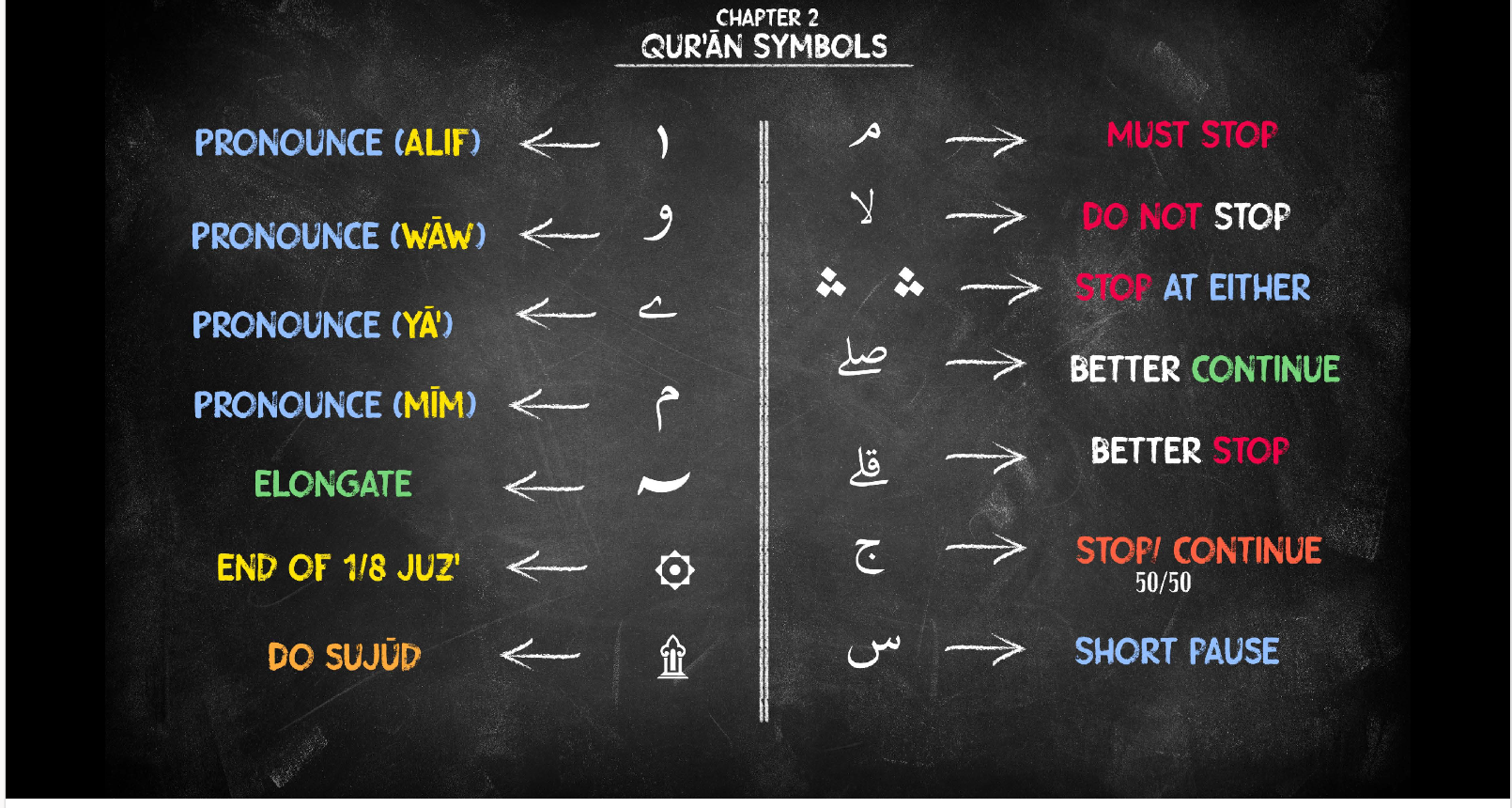
- Find the mark in your mushaf.
- Read the instruction beside the matching symbol.
- Protect the meaning before you stop or continue.
- Remember that editions can differ; your teacher and your own mushaf take priority.
The examples below are clearly labelled teaching examples and are not from the Quran. Use them to notice the rule, then confirm your recitation with a qualified teacher.
ذَهَبَ الطَّالِبُ — dhahaba al-ṭālibu (the student went) — Not from the Quran
Common Mistakes
- Memorising the term translations without checking what each stop does to the meaning.
- Stopping where the continuation would distort the intended sense.
Important Differences
Major Stopping Concepts and Waqf
Study the condition, letters, and sound of Major Stopping Concepts alongside Waqf so the two patterns are not treated as interchangeable.
Compare WaqfMajor Stopping Concepts and Ibtida
Study the condition, letters, and sound of Major Stopping Concepts alongside Ibtida so the two patterns are not treated as interchangeable.
Compare IbtidaMajor Stopping Concepts and Mushaf Stopping Symbols
Study the condition, letters, and sound of Major Stopping Concepts alongside Mushaf Stopping Symbols so the two patterns are not treated as interchangeable.
Compare Mushaf Stopping SymbolsRemember
Judge a stop by its effect on meaning: complete, sufficient, good, acceptable, or unsafe.
Practice
Try to identify the trigger first, say the sound slowly, then listen and repeat. Short, accurate practice is more useful than rushing through many examples.
- What question should a reciter ask before choosing a stop?
- Which stopping categories are considered safe, and which are not?
Question 1 of 2
What is Major Stopping Concepts?
Frequently Asked Questions
Do I have to stop wherever a stop sign appears?
Not always; the notation guides the reciter, and the meaning determines whether a stop is preferred, permitted, or better avoided.
Important Note
Tajweed is best learned through both understanding and listening. Written explanations can help you understand the rules, but correct pronunciation, timing, and articulation are best learned by listening to a qualified reciter or teacher and practicing along with them.
For the best results, combine reading, listening, repetition, and guidance from a qualified Tajweed teacher.