
Quick Facts
- Level
- Intermediate
- Category
- Waqf and Ibtida
- When it occurs
- It applies when a printed stopping symbol appears above or beside a word in the mushaf.
- Letters involved
- Context-dependent
What is Mushaf Stopping Symbols?
The symbols printed in a mushaf are reading guides. In the common Hafs-style notation shown in the poster below, م indicates a required stop, لا indicates that stopping should be avoided, ج allows either stopping or continuing, قلى indicates that stopping is preferred, and صلى indicates that continuing is preferred. A pair of three dots (∴) means the reader should stop at one of the two marked places, not both. Editions differ, and some symbols have additional explanations, so compare the poster with your own mushaf and ask your teacher before applying an unfamiliar mark.
When does it occur?
It applies when a printed stopping symbol appears above or beside a word in the mushaf.
Which letters are involved?
This topic is determined by context rather than a fixed letter set.
How is it pronounced?
The symbol changes the recommended action, not the pronunciation of the letters. Apply it together with the meaning and the stopping form of the final word.
Examples
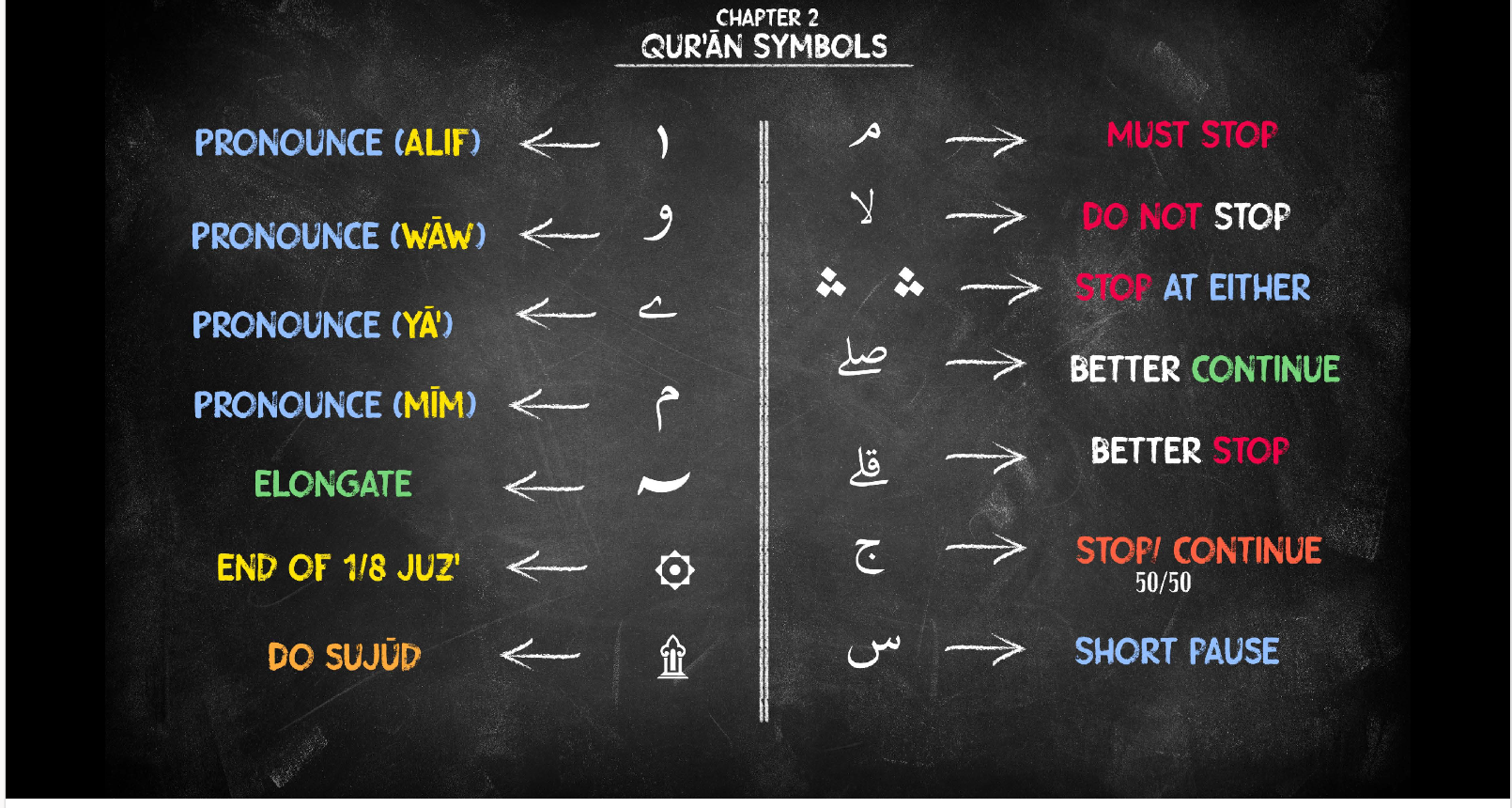
- Find the mark in your mushaf.
- Read the instruction beside the matching symbol.
- Protect the meaning before you stop or continue.
- Remember that editions can differ; your teacher and your own mushaf take priority.
The examples below are clearly labelled teaching examples and are not from the Quran. Use them to notice the rule, then confirm your recitation with a qualified teacher.
دَرْسٌ بَدْءٌ — darsun / badʾun (a lesson / a beginning) — Not from the Quran
Common Mistakes
- Thinking every symbol means ‘stop now’.
- Confusing لا (avoid stopping) with م (stop).
Important Differences
Mushaf Stopping Symbols and Waqf
Study the condition, letters, and sound of Mushaf Stopping Symbols alongside Waqf so the two patterns are not treated as interchangeable.
Compare WaqfMushaf Stopping Symbols and Major Stopping Concepts
Study the condition, letters, and sound of Mushaf Stopping Symbols alongside Major Stopping Concepts so the two patterns are not treated as interchangeable.
Compare Major Stopping ConceptsMushaf Stopping Symbols and When Stopping Affects Pronunciation
Study the condition, letters, and sound of Mushaf Stopping Symbols alongside When Stopping Affects Pronunciation so the two patterns are not treated as interchangeable.
Compare When Stopping Affects PronunciationRemember
Use the symbol as a guide, then confirm the meaning and the correct restart point.
Practice
Try to identify the trigger first, say the sound slowly, then listen and repeat. Short, accurate practice is more useful than rushing through many examples.
- What kinds of guidance do mushaf symbols give?
- Why should the reciter also check meaning rather than follow symbols alone?
Question 1 of 2
What is Mushaf Stopping Symbols?
Frequently Asked Questions
Are the stopping symbols the same in every mushaf?
Not exactly; editions vary, so confirm the meanings for the mushaf you read from, ideally with a teacher.
Important Note
Tajweed is best learned through both understanding and listening. Written explanations can help you understand the rules, but correct pronunciation, timing, and articulation are best learned by listening to a qualified reciter or teacher and practicing along with them.
For the best results, combine reading, listening, repetition, and guidance from a qualified Tajweed teacher.